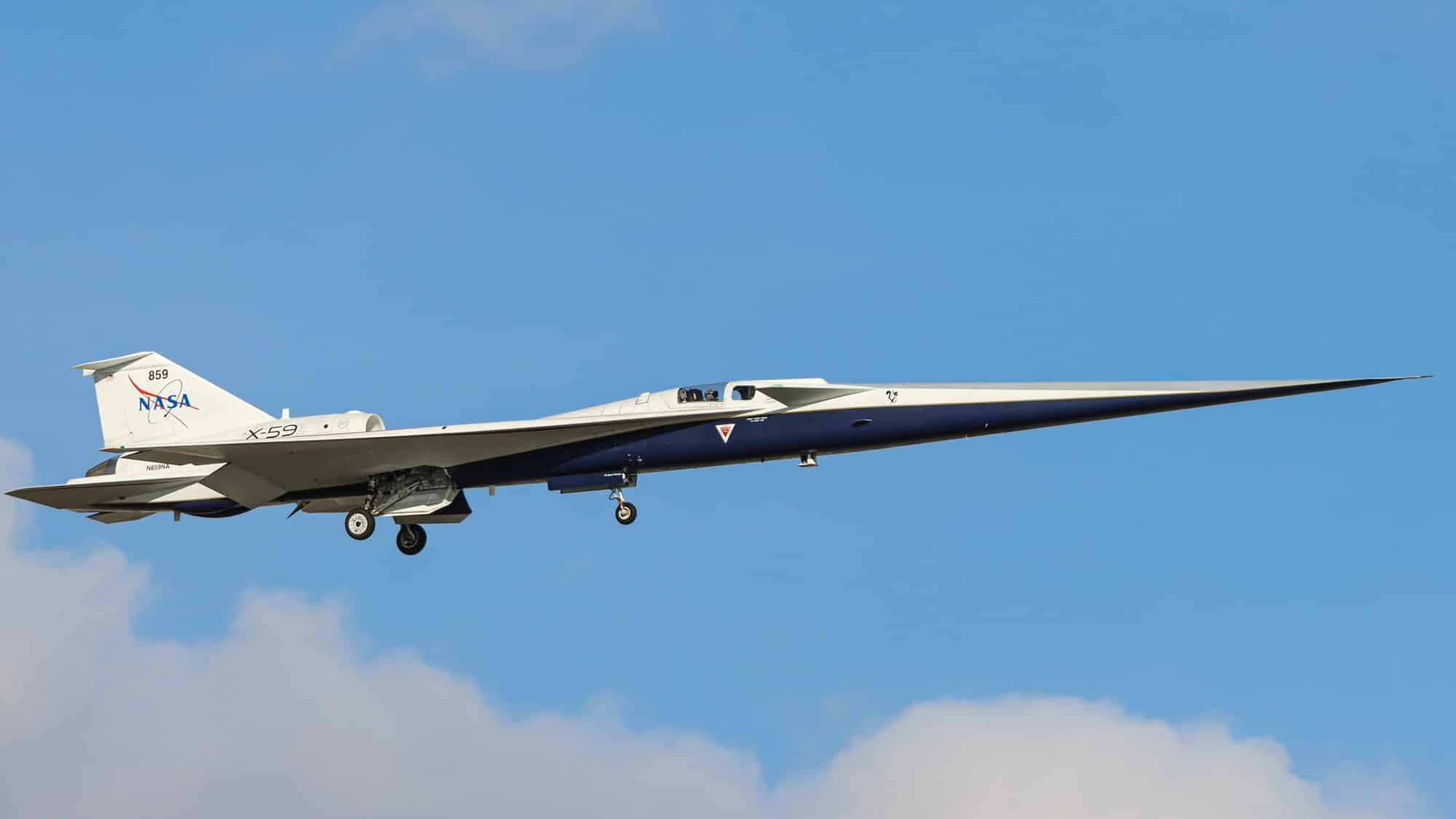
NASA's experimental X-59 QueSST has begun its first journey east from California, heading for the agency's Kennedy Space Center in Florida. The aircraft departed on Oct. 28, 2026 — the same day it marked one year since its maiden flight — according to The Aviationist. After an initial stop in El Paso, Texas, it flew on to Fort Worth, where it landed at Naval Air Station Joint Reserve Base for an overnight stay.
NASA Administrator Jared Isaacman confirmed the destination in comments on video of the landing, The Aviationist reports. The outlet noted that earlier in October it was reported the X-59 was expected to take part in NASA's MAX POWER airshow at Kennedy Space Center on Nov. 7 and 8.
Why it matters
The X-59 is the centerpiece of NASA's Quiet SuperSonic Technology program, which is intended to lay groundwork for supersonic airliners to return to service. The aircraft is built to produce a soft thump rather than a loud boom when it flies faster than sound. According to NASA, the sound reaching the ground will be under 75 perceived decibels — roughly a third less than the Concorde, which was reported at around 100 to 110 dB. The agency has compared the expected noise to a car door closing about 20 feet away.
That quieter signature is central to the program's regulatory goal: gathering data that could support the FAA lifting its 1973 ban on commercial supersonic travel over land.
A year of expanding the flight envelope
The X-59, developed at Skunk Works for NASA's Low-Boom Flight Demonstrator project, first flew on Oct. 28, 2025. Piloted by Nils Larson, that 67-minute flight focused on basic flying qualities and systems checks, according to The Aviationist.
After a scheduled maintenance period, the aircraft returned to flight in March 2026 and began pushing toward higher speeds and altitudes. On June 5, piloted by Jim "Clue" Less, it broke the sound barrier for the first time, reaching about Mach 1.1 at 43,400 feet on an 81-minute flight. A NASA F-15 flew as safety chase, and the agency said the F-15's loud booms drowned out any sound from the X-59.
A week later, on June 12, the aircraft reached its planned mission conditions for the first time — Mach 1.4 at 55,000 feet. Those are the baseline figures for future community overflights, which will collect data on the sound the jet generates and how people on the ground perceive it.
Testing continued through the summer and into autumn. In September, the X-59 flew six times in three days, a record pace for the campaign, and reached Mach 1.53 — about 1,010 mph — its fastest speed at that point. On Oct. 21, test pilot Mike Lippert flew the aircraft for the first time, reaching Mach 1.4 and 55,000 feet after another maintenance period.
By its one-year anniversary, NASA says the X-59 had completed 40 additional flights, climbed above 56,000 feet, and shown it can operate well beyond its initial subsonic conditions.
Engineering behind the quiet boom
The aircraft's most visible feature is a long, tapered nose that makes up nearly a third of its length. The shape is designed to break up the shock waves that normally produce a sonic boom.
Because of that layout, the cockpit sits close to the midpoint of the fuselage, leaving no room for a conventional windshield. NASA instead developed the eXternal Vision System, which the agency describes as an electronic window. A 4K camera ahead of the cockpit supplies the pilot's main view, while a retractable Forward Vision System mounted below the cockpit fills in the lower part of the display where the nose blocks the camera's line of sight. The feed appears on a 4K monitor in the cockpit.
The Aviationist reports that the X-59 is powered by an F41 engine, without giving further detail.
During the Fort Worth landing, the X-59 was accompanied by a NASA F-15 acting as safety chase. A NASA F/A-18 and a Gulfstream C-20 were also tracked along the same route, according to the outlet.
What to watch: whether the X-59 appears at the MAX POWER airshow at Kennedy Space Center on Nov. 7 and 8, and how the program moves from flight testing toward the community overflight phase that will supply the noise data regulators are waiting on.